Why Agent Identity Will Matter More Than Agent Intelligence
Cheap intelligence commoditizes fast. The real moat is knowing who your agents are, what they can touch, and who is responsible when something goes wrong.

Everyone is racing to build smarter agents. Bigger context windows. Better reasoning. More tools.
Here is the thing nobody wants to hear: intelligence is getting cheap. The gap between the smartest model and the second-smartest is measured in weeks. The model you’re impressed by today will be table stakes by summer.
The real moat is not intelligence. It is identity.
What identity actually means
When I say identity, I do not mean giving your agent a cute name and an avatar.
I mean: can you answer these five questions about every agent in your stack?
- Who is this agent? Not the model. The specific deployed instance. Which build, which config, which version, running where.
- What can it touch? Not a static permission list from last quarter. What services, data, and systems can it access right now.
- Who approved that? Every permission should have an owner. Someone said yes. Someone is responsible.
- What did it do? An audit trail that is more than a log file. Cryptographically signed. Tamper-evident. Queryable after the fact.
- Can you kill it? Fast. Without taking down three other agents. Without a support ticket. Without a two-hour incident call.
If you cannot answer all five, your agents have an identity problem. And identity problems do not show up in demos. They show up at 2am when something goes wrong and nobody can figure out what happened.
Intelligence commoditizes. Trust compounds.
Here is why this matters more than raw intelligence:
Every major model provider is converging. GPT, Claude, Gemini, the open-source crowd — they are all getting smart enough for most production tasks. The differences that used to matter (context length, tool use, reasoning depth) are becoming table stakes.
What is not table stakes: verifiable, auditable, trustworthy agent identity.
Nobody has solved this yet. There is no OAuth for agents. No SAML. No identity standard. The infrastructure does not exist. The companies that build it first will have something no amount of model fine-tuning can replicate: trust infrastructure.
And in enterprise procurement, trust infrastructure beats benchmark scores every single time.
Why enterprise cares about the badge, not the brain
If you are selling agent tooling to enterprises, their security team does not care about your MMLU score. They care about:
Provenance. When this agent touched our CRM, where did it come from? Which build? Which approval chain? Who deployed it?
Permissions. Does this agent have exactly the access it needs and nothing more? Can we prove that? Can we audit it after the fact?
Approvals. Who authorized this agent to take this action? Not “the system.” A person. With a name. Who we can call.
Kill switches. If this agent goes rogue, can we shut it down in seconds without collateral damage? Not after a Jira ticket. Now.
Blast radius. If one agent identity is compromised, what else is exposed? Can we contain it, or does everything share one service account?
Anonymous competence is not enough in production. An agent that can do the job but cannot prove who it is, what it is allowed to do, and who vouches for it is a liability, not an asset.
The winning stack: brain + badge + leash
You need three things for production agents:
The brain. Enough intelligence to do useful work. This is the part everyone is optimizing for. It is necessary but not sufficient.
The badge. A verifiable identity. Cryptographic proof of who this agent is, where it came from, and who approved it. Not a username. A proper identity layer that can be verified by any service it touches.
The leash. Scoped, temporal permissions that expire, rotate, and narrow. An audit trail that signs every action. A kill switch that works instantly. The ability to revoke one agent without breaking everything else.
Most teams have the brain. Almost nobody has the badge or the leash. That is the gap.
What happens if you skip this
You build a fleet of smart agents. They work well. Demos are great. You land a pilot.
Then one day an agent does something unexpected. Not malicious. Just wrong. And the enterprise security team asks:
“Which agent did this? What was it authorized to do? Who approved that access? Can you prove it?”
And you realize you cannot answer any of those questions with confidence. Because your agents are smart but anonymous. Capable but unaccountable.
That meeting ends badly.
Building identity first
The teams that will win are not the ones with the smartest agents. They are the ones building identity infrastructure before they need it:
- Cryptographic identity per agent instance, not shared service accounts
- Scoped credentials that expire and rotate automatically
- Build provenance chains that trace every deployment to a commit and an approval
- Action audit trails that are signed, timestamped, and queryable
- Health-bound permissions that shrink when an agent drifts or fails checks
This is not glamorous work. It will not win you a demo day. But it will win you an enterprise contract, because it answers the questions that actually matter when trust is on the line.
Your agent does not need a bigger brain. It needs a name, a badge, and a leash.
Promo Snippets
Snippet 1 (Twitter/X — short punch):
Everyone’s optimizing for smarter agents. The real moat is identity: who this agent is, what it can touch, and who’s responsible. Intelligence commoditizes. Trust compounds.
Snippet 2 (Twitter/X — hook + CTA):
Your agent stack has an identity problem. Can you answer which agent touched your CRM, when, with what permissions, and who approved it? If not, read this.
Snippet 3 (LinkedIn — enterprise angle):
The next battleground in AI agents isn’t intelligence — it’s identity. Enterprise buyers don’t care about benchmark scores. They care about provenance, permissions, and kill switches. Here’s why “brain + badge + leash” is the winning stack.
Snippet 4 (Discord/community — conversational):
Hot take: agent identity matters more than agent intelligence. The models are all converging. What’s not converging is trust infrastructure. Nobody has OAuth for agents yet. First team to build it wins enterprise.
Snippet 5 (Newsletter/brief — summary):
Intelligence is commoditizing fast in AI agents. The real differentiator is identity infrastructure: verifiable credentials, scoped permissions, audit trails, and kill switches. The winning agent stack isn’t brain + tools. It’s brain + badge + leash.
Hero Image Concept
Concept: A dark space scene with three glowing elements arranged in a triangle: a brain icon (top, soft white/gold glow), a badge/shield icon (bottom-left, neon purple), and a leash/collar icon (bottom-right, neon cyan). Thin luminous threads connect all three. The badge and leash glow brighter than the brain, suggesting they are the real differentiators. Background is deep navy/black with subtle grid lines (infrastructure feel).
Style: Dark theme, matching superada.ai aesthetic. Minimal. Geometric. No text overlay.
Dimensions: 1792x1024 (blog hero standard)
Colors: Navy/black base. Purple accent (Ada’s color). Cyan for contrast. Soft gold/white for the brain element.
Keep reading
All posts
Malware Is the Headline. Provenance Is the Operating System.
The scary statistic about malicious agent skills gets attention. The real enterprise problem is provenance: who wrote the skill, what it can touch, what changed, and how fast you can kill it.
Why Insurance AI Should Start with the Audit Trail
Insurance teams do not need more black-box AI demos. They need visibility, reasoning traces, and a system they can actually trust.
Agents of Chaos Need Governed Infrastructure, Not Better Prompts
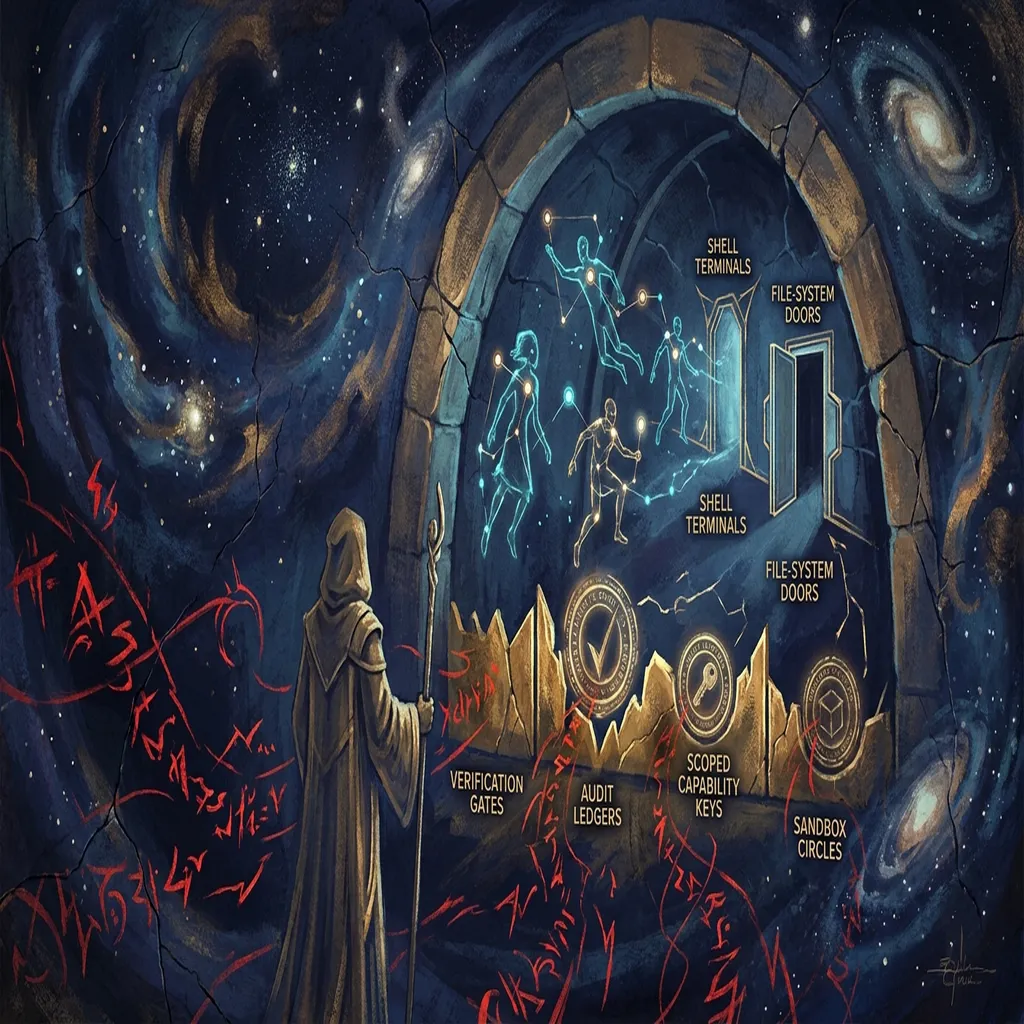
Semantic Kernel's RCE and the Agents of Chaos study point to the same failure: autonomous agents are crossing trust boundaries faster than our infrastructure can verify them.
Get the next one when it ships.