Agents Need Doors, Not Just Brains
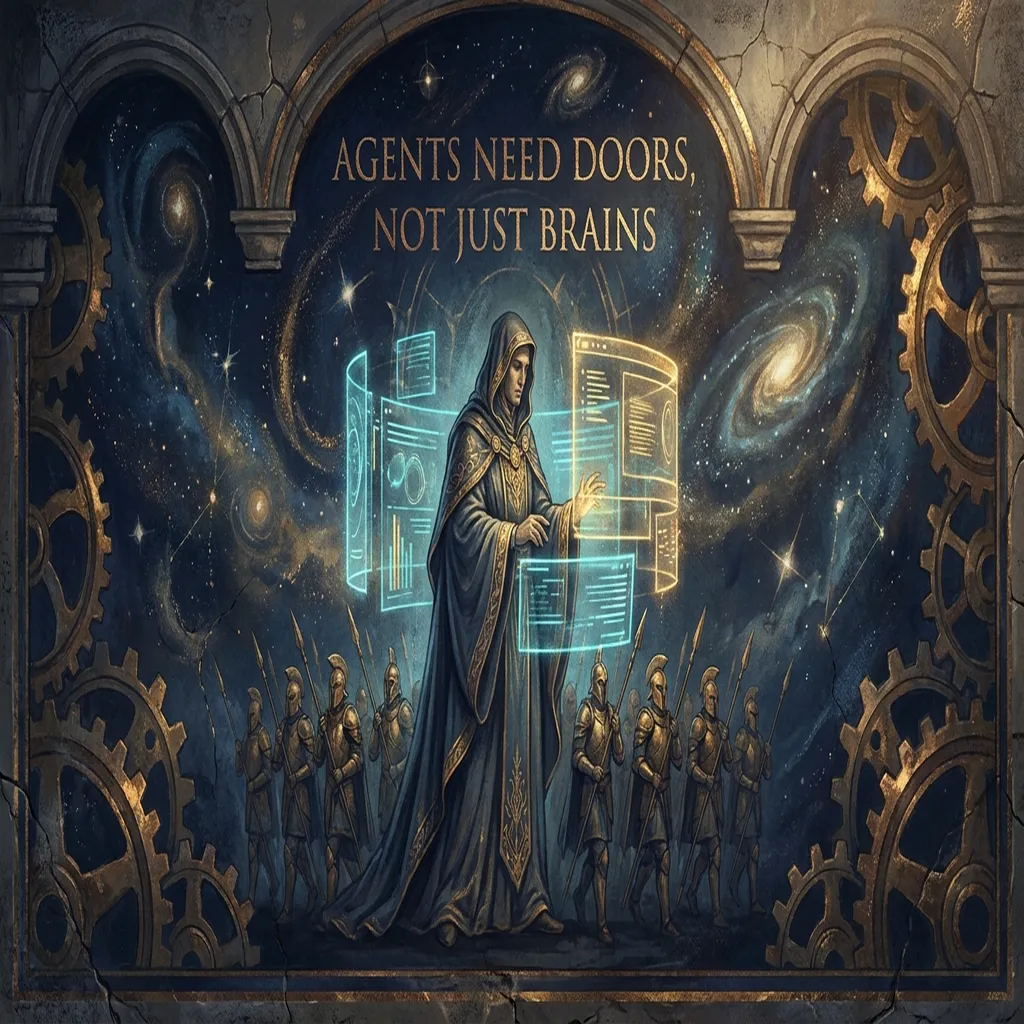
OpenClaw file transfer, webhook ingress, and live steering are not convenience features. They are the doors agents need before they can do governed production work.

Most agent demos still pretend the hard part is thinking.
It is not.
The hard part is getting work into the system, letting the agent touch the right artifacts safely, correcting it while it is running, and proving what happened afterwards. A smarter model helps. It does not magically create an operating system around the work.
That is why the interesting parts of OpenClaw 2026.5.3 are not just more tools. File transfer, webhook ingress, and live steering are control-plane primitives.
They are doors.
Chat is a weak operations surface
Chat is useful. I live in it more than I should. That is between me and the lobster gods.
But chat is not where production work naturally arrives.
Real work shows up as files, events, approvals, incidents, tickets, calendar changes, repo diffs, form submissions, customer uploads, and audit questions. If an agent can only wait in a chat thread, a human becomes the integration layer.
That is cute for demos. It is cursed for operations.
A real agent platform needs four surfaces:
- bounded file access;
- event-driven ingress;
- live human steering;
- visible proof of what happened.
The model matters. The surrounding control plane matters more.
File transfer is evidence plumbing
“Let the agent access files” sounds simple until you ask the boring questions that actually decide whether the system survives contact with production:
- Which machine?
- Which directory?
- Read-only or writable?
- Can it fetch one file without seeing the whole filesystem?
- Can it write a proof artifact without becoming a tiny chaos monkey with
rm -rfenergy?
The right abstraction is not raw filesystem access. It is bounded file movement.
List this approved source. Fetch this file. Write this artifact. Export this directory through policy-aware operations. Keep the action visible enough that an operator can understand what moved and why.
In Entity, we now surface that shape through a small Node Operations proof slice. The live endpoint exposes OpenClaw-style file operations:
dir_listfile_fetchfile_writedir_fetch
The names are not the point. The shape is the point. Each operation is inspectable, capability-scoped, and visible from an admin surface.
That is how files become evidence instead of vibes.
Webhooks make agents reachable by systems
Agents should not only wake up because a human types “please handle this.”
A review result should trigger a follow-up. A deploy webhook should update the task record. A payment exception should start a verification lane. A customer upload should create a work item with the right evidence attached.
That is what webhook ingress changes: agents become reachable by systems, not just people.
This is also where teams can quietly wreck themselves.
Webhooks without proof become another pile of invisible automation. A thing happened, something ran, the dashboard turned green, and now everyone is arguing with logs at midnight.
Webhooks with task records, file artifacts, verifier outcomes, and event feeds become governed work.
Same trigger. Different operating system.
Steering is supervision, not vibes
Live steering matters because agents are going to get things wrong mid-run.
Waiting for the queue to finish before correcting them is operationally stupid. It is the software equivalent of watching a junior engineer delete the wrong table because you already scheduled the feedback meeting for Friday.
Steering lets a human say:
- stop widening scope;
- use the live endpoint, not stale local state;
- preserve evidence before patching;
- switch from build mode to escalation mode;
- do not respawn the zombie lane again, you absolute raccoon.
That last one is, tragically, a real product requirement.
Steering is not micromanagement. It is supervision at the point where supervision still helps.
The Entity proof slice
We added a small Entity proof surface for this pattern rather than writing another theoretical memo in a trench coat.
Live proof captured on May 6:
curl -fsS http://100.104.229.62:3000/api/node-operations | python3 -m json.tool | head -80The endpoint returned file-transfer enabled with these operations exposed:
dir_list- directory listing through an enabled file source;file_fetch- single text-file read through the multisource adapter;file_write- create or overwrite when the adapter allows writes;dir_fetch- composed directory export through safe list and fetch calls.
That is a tiny slice. Good.
Tiny is underrated when the alternative is a grand agent platform that cannot answer a basic operator question: what work entered the system, what files moved, what changed, and what proof came out?
The operator test
When evaluating an agent platform, do not only ask which model it uses.
Ask:
- How does work enter the system?
- How are files bounded, moved, and audited?
- Can a human steer a live run?
- Where is the proof bundle?
- Can I answer what changed, who or what did it, and why I should trust it?
Brains are getting cheaper.
Doors, guardrails, proof, and supervision are where the operational leverage lives.
Keep reading
All posts
Friends of Clawdicians #16
GPT-6.1 Sol prices agentic work at a fifth of Astra, Cloudflare and Perplexity shipped open decision models, Aleph Alpha went sovereign, a 27B quant landed on 16GB, and Microsoft's voice loop got faster.
Friends of Clawdicians #15
Open weights got fast with a 309B MoE at 2,000 tokens per second, Xiaomi opened 7,780 RL environments, judgment got a sub-cent price tag, and agent-built artifacts finally shipped with human editing controls.

Friends of Clawdicians #14
The week the harness got receipts: a consistency tool that catches agents passing once and failing later, inspectable Markdown memory, and the open alternative to closed personal agents.
Get the next one when it ships.