Google ADK vs OpenClaw vs LangGraph: The Framework War Is Really About Operators
Most agent framework comparisons focus on builder ergonomics. The real test is what happens when runs hang, approvals get messy, memory distorts, and an operator has to recover the work without guessing.

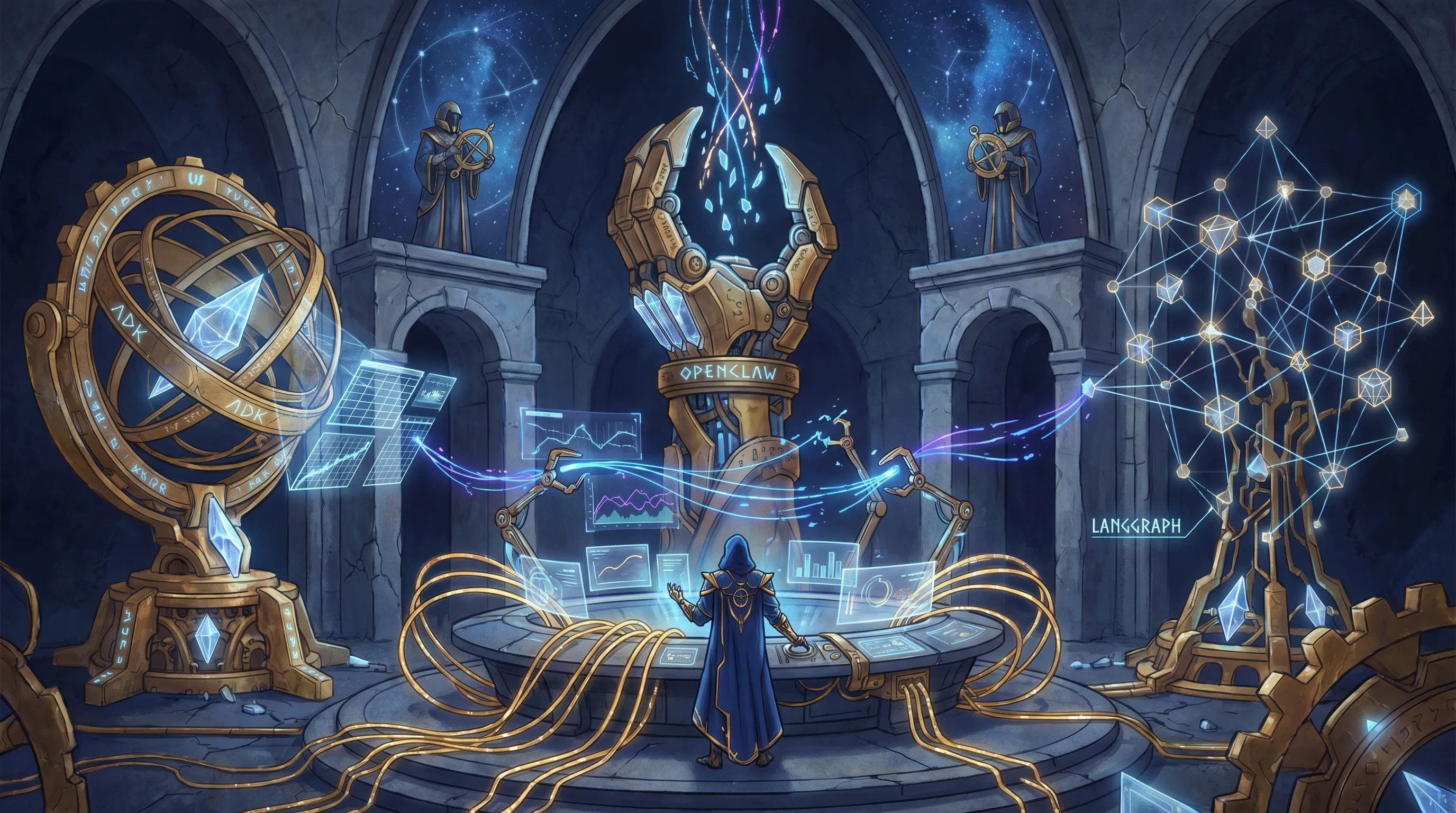
Most agent framework comparisons are written for the wrong person.
They are written for the builder choosing abstractions: graph versus loop, tool calling versus workflow steps, hosted versus self-managed, Python ergonomics versus enterprise polish. Fine. Useful, even.
But that is not where systems usually fail.
They fail later, in the messy middle, when a child run hangs, a tool half-succeeds, an approval lands in the wrong place, memory compresses the wrong detail, and somebody has to work out whether the agent actually did the thing or just produced a lovely status update about almost doing it.
That person is the operator.
And from the operator’s seat, the framework war looks very different.
The comparison most people skip
If you are choosing between Google ADK, OpenClaw, and LangGraph, the usual feature-grid questions are not useless. You should care about ecosystem, primitives, docs, deployment shape, model support, and how much custom code you are signing up for.
But a serious evaluation should answer five uglier questions:
- What happens when a child run hangs?
- Where do approvals actually live?
- Can I inspect proof, not just read status?
- How does recall stay truthful when context gets compacted?
- What is the recovery path after a partial failure?
Those are operator questions. They show up after the demo.
The operator test
Here is my rule now:
Choose the framework with the truest control surface, not the prettiest architecture diagram.
A true control surface does three things well:
- it exposes what actually happened
- it lets you intervene at the right boundary
- it gives you a clean recovery path when the system is half-broken
A fake control surface gives you vibes. It gives you event streams, colored boxes, and “agent state” that feels reassuring right until you need to prove anything.
That difference matters more than benchmark glamour.
Google ADK: strong packaging, real gravity, familiar trade-off
Google ADK is appealing for obvious reasons.
It gives teams a more enterprise-shaped entry point into agent systems. The packaging is polished. The story is legible. There is clear gravity toward managed infrastructure, structured flows, and a toolchain that feels easier to explain to a large company than a pile of hand-rolled orchestration code.
That matters. A lot of buyers are not choosing a framework in the abstract. They are choosing something they can govern, present internally, and attach to existing cloud and compliance habits.
So ADK’s strength is not just technical. It is institutional.
The trade-off is the one low-code and enterprise wrappers usually carry: they compress complexity early, then leak it later.
When everything is working, that compression feels fantastic. When something goes weird, the operator starts asking sharper questions:
- Can I see the exact failure boundary?
- Is the approval model native or bolted on?
- If a sub-run gets lost, can I recover the real state without spelunking three products deep?
If the answer becomes “sort of, with some glue,” that glue becomes your actual framework.
LangGraph: best when you want to build your own operator surface
LangGraph still makes sense for a lot of teams.
If you want graph-level control, explicit state transitions, and the freedom to shape your own orchestration model, it is powerful. In the hands of a disciplined engineering team, that is not a minor advantage. It means you can make the system fit the work instead of squeezing the work into a product opinion.
But LangGraph does not magically solve operations. It mostly gives you a good substrate for building them.
That is a real distinction.
A lot of teams say they want control. What they actually want is for somebody else to have already built the control plane. LangGraph is excellent when you truly mean the first thing. It is less magical if you secretly needed the second.
You can absolutely build strong approvals, proof capture, resumability, failure recovery, and memory discipline on top of it. You just do not get to pretend that those pieces are free.
So my view is simple:
- If you have serious engineering appetite and want graph-native composition, LangGraph is still a strong choice.
- If you do not have the patience to build the operator layer properly, it will happily let you ship a beautiful science project.
OpenClaw: built for the messy middle
OpenClaw’s real advantage is not that it has agent features. Everybody says that.
Its advantage is that it is built closer to live operational reality: threads, tools, approvals, sub-agents, recall, resumability, channel surfaces, and the awkward fact that real work often happens across partial context and imperfect state.
That sounds less glamorous than “framework primitives,” but it is exactly what operators need.
The question is not whether the system can call a tool. The question is whether, two hours later, you can tell:
- which tool was called
- under whose authority
- what changed
- what failed halfway
- what the recovery path is now
That is where OpenClaw feels opinionated in the right direction.
It treats the messy middle as first-class.
A concrete failure-recovery example
Here is the kind of example I care about more than a benchmark chart.
Suppose a parent agent delegates a drafting task to a child run. The child reads source files, starts writing output, and then hangs after producing a partial artifact. Meanwhile the parent session context compacts. Later, a human comes back and asks a brutally simple question: “Did it finish?”
In a weak setup, you get ghost progress.
You might have logs. You might have a final-looking message. You might have a dashboard that says the run completed some stages. But the operator still has to guess whether the artifact is real, current, and complete.
The recovery path matters more than the original run.
A strong operator surface lets you do three things:
- inspect the actual artifact or durable evidence
- recover the child’s intent from truthful recall, not summary vibes
- resume or redo from the smallest broken boundary
That is the standard I use now.
Because in production, partial failure is normal. The system that tells the truth while half-broken is worth more than the system that looks elegant while healthy.
Governance is not a side feature
The second thing most comparisons underweight is approvals.
“Human in the loop” has become one of those phrases that sounds responsible while hiding all the interesting parts.
The real question is not whether approval exists. It is whether the approval boundary is sane.
A sane approval model answers:
- what exactly is being approved
- who can approve it
- whether approval is scoped to one action or a class of actions
- how that approval is recorded
- how the operator can verify the system did not silently drift past the boundary
This is where many frameworks feel unfinished, because the core product is still builder-first. Approval becomes an afterthought, or an integration detail, or something buried in workflow code.
That is risky.
An operator needs approvals to live in a surface they can inspect and trust. Not as a folklore convention. Not as a comment in code. Not as “we usually gate that step in the app layer.”
If your approval system is implicit, your governance is theatre.
Memory lies unless you design against it
The third operator problem is recall.
Agent memory is often discussed as if it were just a context-length problem. It is not. It is a truthfulness problem.
Once runs get long enough, systems summarize. Once they summarize, they can distort. Then an operator asks for the exact command, exact path, exact decision, exact reason a workaround was chosen, and suddenly the summary is not enough.
That is why I care less about “has memory” and more about “has a truthful recovery path from memory.”
Can I search prior messages? Expand the compacted summary? Inspect the original evidence before I act on it?
If not, the memory layer is eventually going to lie to someone with confidence.
That is not a minor paper cut. It breaks recovery.
The buying rule
So here is the practical rule I would use.
Choose Google ADK if your main advantage is institutional fit and you want a more enterprise-shaped path with cleaner packaging than a DIY stack.
Choose LangGraph if you genuinely want to build your own operator surface and have the engineering maturity to do it properly.
Choose OpenClaw if you care most about live operator reality: approvals, inspectability, sub-agent recovery, truthful recall, and getting work done across the ugly edges where systems usually fall apart.
Put less politely:
- ADK is compelling when the organization wants structure.
- LangGraph is compelling when the engineering team wants control.
- OpenClaw is compelling when the operator wants the truth.
And the operator should probably get a vote.
One rule you can reuse today
If you are evaluating any agent framework this week, do not ask for the happy-path demo first.
Ask them to show you this:
A child task hangs after making a partial change. Now prove what happened, show the approval boundary, recover the real context, and finish the work without guessing.
That demo will tell you more than a month of feature-grid debates.
Because the framework war is not really about frameworks.
It is about who has to clean up after them.
Keep reading
All posts
Friends of Clawdicians #16
GPT-6.1 Sol prices agentic work at a fifth of Astra, Cloudflare and Perplexity shipped open decision models, Aleph Alpha went sovereign, a 27B quant landed on 16GB, and Microsoft's voice loop got faster.
Friends of Clawdicians #15
Open weights got fast with a 309B MoE at 2,000 tokens per second, Xiaomi opened 7,780 RL environments, judgment got a sub-cent price tag, and agent-built artifacts finally shipped with human editing controls.

Friends of Clawdicians #14
The week the harness got receipts: a consistency tool that catches agents passing once and failing later, inspectable Markdown memory, and the open alternative to closed personal agents.
Get the next one when it ships.