The One-Tap Beta Approval Loop: How HeraldLabs Release-QA Runs Without You
Release-QA automation for OpenClaw betas, with one human decision per packet and zero routine pings.
Every OpenClaw beta release used to drag Henry into a half-day of pings. Detection, packet build, dispatch, follow-ups, evidence back-and-forth, adjudication, an upstream filing pass. Each step ran on its own message and its own wait window. Henry was the only human in the picture. The crew was loud. Henry was tired.
The HeraldLabs release-QA autonomy mode flips that loop. Four cron jobs run the whole pipeline now. Henry wakes up for four types of decision, one at a time, in one Discord thread. Everything else is mechanical, recorded, and reversible by a freeze script.
This is the operator manual. Read it now. Read it again at 2am.
The four human-only decisions
The whole interface is one channel. It’s Discord thread 1511147437329485977 in the Herald Labs guild. Cron posts the evidence and a recommendation. Henry replies with one verb. No ticket, no Slack DM, no separate approval surface.
| Decision | Trigger | What cron posts | Henry replies | What happens next |
|---|---|---|---|---|
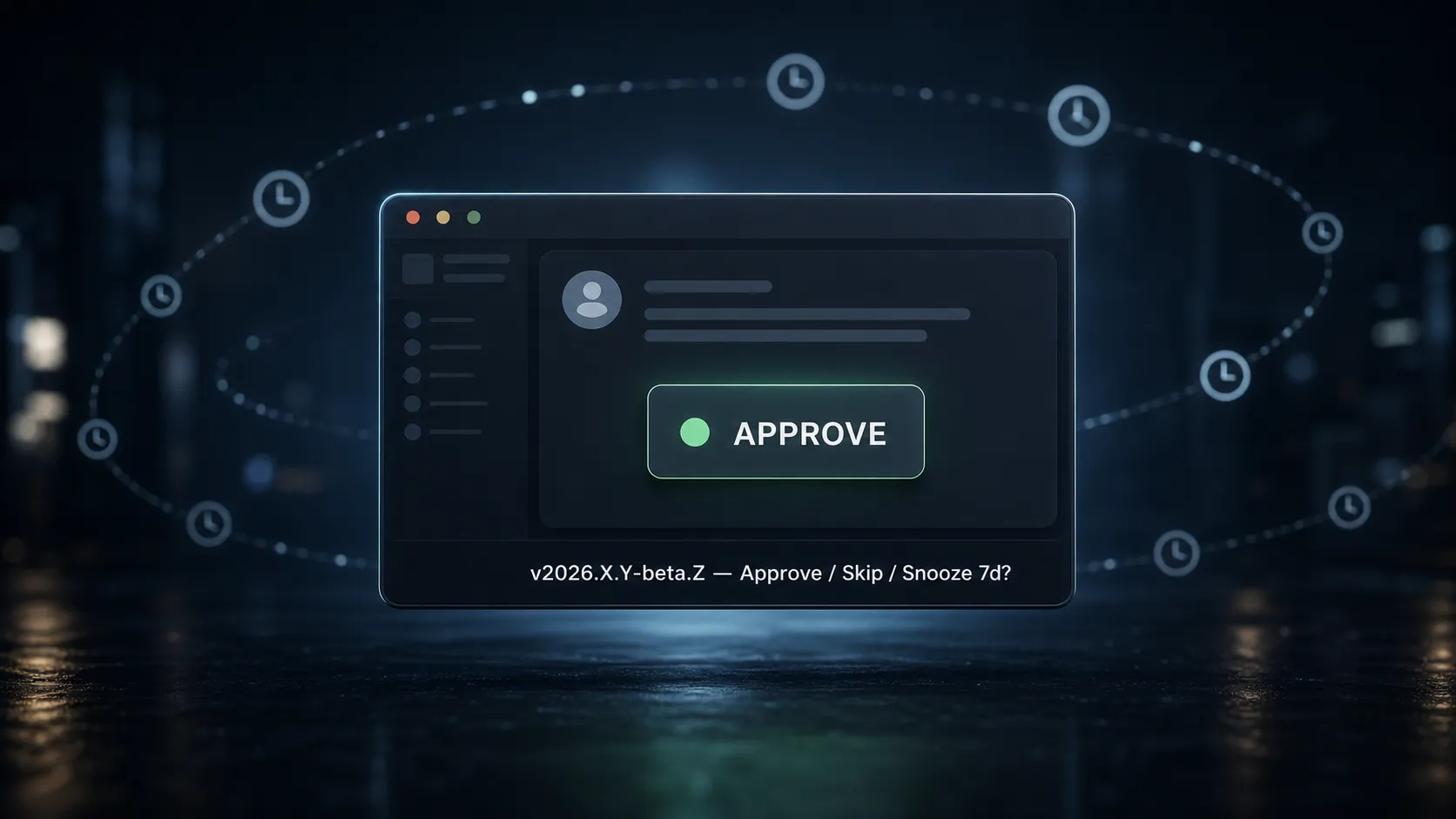
| H1 Dispatch the new beta | Watcher detects a new v2026.X.Y-beta.Z upstream | v2026.X.Y-beta.Z published - Approve / Skip / Snooze 7d? plus a 5-line packet preview and a token | APPROVE / SKIP / SNOOZE Nd | Manager records the approval. Next tick dispatches testers. |
| H2 File or skip a real bug | Manager adjudicates a FAIL_FILE_ISSUE report | Bug summary, dedupe hits, draft body, source-report link | FILE / SKIP-BUG / WAIT | Cron files upstream on auto_file, marks the report waived, or holds for evidence |
| H3 Approve an irreversible action | A key rotation, public hardening disclosure, or leaked-key path needs to run | Proposed action, blast radius, rollback path | APPROVE (explicit, never assumed) | key_rotation lane passes only with a matching token. No auto-apply. |
| H4 Unblock a stuck cohort | A cohort sits blocked more than 72 hours with no progress | Actual blocker, who’s waiting, next concrete help path | UNBLOCK <next action> | Manager routes the help path. Records the resolution. |
That’s the whole interface. Every other ping in the system is suppressed, batched, or auto-handled. If a message in that thread isn’t one of these four, it’s a duplicate. Ignore it.
The cron side, end-to-end
Two crons drive the loop. Both run on the Hermes scheduler. Both are owned by Book on the backoffice side and by Ada/SuperAda for any public Discord-visible message.
Watcher 51169e3a0a39 fires every 30 minutes. It runs openclawqa_beta_poll.sh against openclaw/openclaw releases.
When a new beta lands, the script does four things and stops:
- Writes the run folder under
/Users/enterprise/Code/openclawQA/runs/<tag>/. Eleven artifacts land in one pass:release-context.md,qa-checklist.md,adversarial-review.md,evidence-manifest.md,tester-instructions.md,freshness-report.md,triage-notes.md,closeout-report.md,tester-status.md,run.json, andreceipts/*.json. - Commits and pushes to
HeraldLab/OpenclawQAviavalidate-run.ymlandrender-index.yml. - Posts one notification to thread
1511147437329485977. It looks likev2026.X.Y-beta.Z published - Approve / Skip / Snooze 7d?and carries an approval token. - Stops. No dispatch. No per-tester packet. No upstream filing. No other public action.
If the watcher sees another beta before the old one is approved, it posts one follow-up reminder. The reminder points at the original approval message id. It never spams the thread with duplicate packets.
Manager 46d73e9d7717 fires every 15 minutes. It reads the watcher state, the approval thread, the per-tester threads, the tracker, and the action log. On each tick:
- If a new beta is unapproved, the manager holds. The watcher owns the initial approval post.
- If Henry replied
APPROVE, the manager runs/Users/enterprise/.hermes/scripts/heraldlabs-public-lock.py record-approval --actor book --lane auto_dispatch --token <token> --decision approved --message-id <henry_reply_message_id>. That unlocks the freeze. - Once the token is recorded, the manager dispatches testers via the Ada/OpenClaw CLI to per-tester threads. The lock script checks
--lane auto_dispatchwith the recorded token before every send. A dispatch without a token returnsLANE_REQUIRES_APPROVAL_TOKEN. Nothing goes out. - Reports flow back into GitHub Issues on
HeraldLab/OpenclawQA. The manager adjudicates row by row and writes a verdict JSON. PASS_COMPLETEandPASS_WITH_CAVEATare auto-accepted. They land in CSV, profiles, and MC task #704.INCOMPLETE_NEEDS_EVIDENCEandBLOCKED_NEEDS_HELPget one follow-up per tester per cycle.FAIL_FILE_ISSUEwaits for Henry’sFILE/SKIP-BUG/WAITdecision on H2.- When all 5 active testers hit
PASS_COMPLETEorPASS_WITH_CAVEATfor a packet,cohort_readinessflips toREADYautomatically.
The freeze machine
The four lanes in heraldlabs-public-lock.py exist so cron keeps working while public sends are otherwise frozen. Each lane has a typed token namespace, a cooldown to stop runaway loops, and one decision path that records Henry’s reply in thread 1511147437329485977.
| Lane | Cooldown | What it covers | Token required | Without a token |
|---|---|---|---|---|
auto_packet_gen | 60s | Watcher generating a packet and the approval ask | Optional | Falls back to legacy |
auto_dispatch | 30s | Tester dispatch after Henry approves a beta | Yes | LANE_REQUIRES_APPROVAL_TOKEN |
auto_file | 120s | Filing an upstream GitHub issue after Henry says FILE | Yes | LANE_REQUIRES_APPROVAL_TOKEN |
key_rotation | 300s | Rotating a HeraldLabs LiteLLM or shared key | Yes | LANE_REQUIRES_APPROVAL_TOKEN |
legacy | n/a | Anything not in the four lanes above | No | FREEZE_ACTIVE if freeze is set |
The freeze is file-based on purpose. /Users/enterprise/.hermes/public-action-lock.json is shared state between Ada, Book, shell scripts, and future agents. One source of truth, no prompt-memory dependency. The legacy lane still freezes. The four autonomy lanes only unblock when a matching recorded approval is present.
The Risk Surface Intercept Matrix
The matrix is the spine of every packet. Rows are failure surfaces, not changelog bullets. The brief is scored before testers dispatch. Tester execution is only judged against rows the brief assigned. Without that rule, the system blames testers for surfaces no one ever asked them to cover.
The matrix was retrofitted after a three-release eval on v2026.6.1-beta.1, v2026.6.1-beta.2, and v2026.6.1-beta.3. Each release exposed the same shape of failure. Brief coverage was weak. Dispatch was uneven. Evidence was incomplete. Adjudication ran stale. The eval classified the misses as BRIEF_MISS, BLAST_RADIUS_MISS, PROOF_MISS, PROCESS_GATE_MISS, and ORACLE_MISS. None of them were tester execution failures. No release had assigned rows plus proof plus dispatch receipts in the same place.
The ordering rule baked into the matrix is the only way the system stays fair:
- Build the release risk surface from changed files, release notes, PRs, and upstream issue signals.
- Score QA brief coverage against that surface. Anything missing is a
BRIEF_MISSorBLAST_RADIUS_MISS. Never a tester miss. - Score tester execution only against rows the brief assigned. No dispatch receipt means
PROCESS_GATE_MISS, not tester miss. - Score proof quality separately.
That ordering rule is why v2026.7.1-beta.1 shows testers: [] in its run.json and is still a valid run. The dispatch lane never fired. There’s no tester to score. The system holds itself accountable for the process gap instead of manufacturing a fake score.
Worked example: v2026.7.1-beta.1
v2026.7.1-beta.1 was published upstream at 2026-07-02T07:25:49Z. The watcher detected it at 2026-07-02T08:01:24Z. The run folder landed in one pass. All 11 artifacts are on disk under /Users/enterprise/Code/openclawQA/runs/v2026.7.1-beta.1/. The freshness report confirmed target_exists: true, latest_beta: v2026.7.1-beta.1, stable_baseline: v2026.6.11. The release context pulled 222 merged PRs and 38 KB of release notes. Highlights: GPT-5.6 support, the new openclaw attach harness workflow, Telegram Codex steering, event-driven on-exit cron schedules, the iOS 26 visual refresh, iMessage polls. Plus a long list of Telegram, agent-context, provider, channel-routing, memory, Windows, and gateway fixes.
The closeout status is closed_initial_dry_run. The run.json shows:
discord_thread: nulltesters: []upstream_issues: []freshness.pre_send_checked_at: null
That’s not a bug. The watcher ran in autonomy mode for the first time and stopped at the approval ask. That’s correct behavior. The dispatch lane fell into dry-run mode. That’s the known gap. It’s the only thing that has to flip before the next beta. The freeze is doing its job: no tester was dispatched without a recorded Henry approval.
When the dispatch-ask message lands in thread 1511147437329485977, the move is simple. Reply APPROVE. The next manager tick records the approval token and dispatches testers to their existing per-person threads. Five testers are active in the cohort: Samuel, Ayomide, Miriam, Anny, and Gabriel. Their current cohort_readiness is READY from the prior cycle. Gabriel’s row is already moved to closed in testers-template.csv.
If the live-dispatch path is still in dry-run mode when the next beta lands, Henry replies APPROVE and nothing happens. That’s the signal to look at openclaw-beta-poll.py. It’s not a signal to blame cron.
What Henry does not do
The whole point of the autonomy mode is that the human stops being the dispatcher. Here’s the list of ping types that no longer fire:
- Stale-tester within SLA. Inside the 2–3 hour window, one per-person follow-up routes via manager cron. No all-hands ping.
- Individual PASS_WITH_CAVEAT acceptances. Auto-accepted into CSV, profile, and MC #704. Caveats surface in the cohort readiness card, not in Henry’s inbox.
- Hardening backlog items. Batched into one
#release-approvalspost. OneFILEorSKIPreply covers the whole batch. - Legacy approval packets. Auto-superseded when the next beta publishes. The current packet supersedes. The old one is marked stale.
- Waive or close decisions for already-PASSed cohorts. Closed at adjudication. Recorded in the tester profile. No second confirmation.
- Duplicate suppression events. Suppressed silently. Manager records the SKIPPED duplicate with the existing message id and moves on.
What can break
A real list, not a marketing one.
Dry-run vs live-dispatch gap. The dispatch lane in openclaw-beta-poll.py defaults to dry-run mode. That’s the v2026.7.1-beta.1 issue. Until the default flips to live dispatch under the recorded approval token, every new beta will sit at closed_initial_dry_run and never reach testers.
Action Gate scope drift. The scope YAML lives in both trees. Code tree: /Users/enterprise/Code/agent-action-gate/config/herald-labs-scopes.yaml. Services tree: /Users/enterprise/Services/action-gate/config/herald-labs-scopes.yaml. The Services tree is what the live gateway reads. Editing the Code tree without mirroring to Services is a silent no-op.
The four thread scopes for 1511147437329485977 were added to both trees. They cover book-owner and ada-owner, in guild and default-account variants. Scope count went from 59 to 63 to 65. The service restarted and /reserve-outbox probes came back clean: book = reserved, ada/superada/spock = non_owner_denied. Anyone editing scopes needs to keep both trees in lockstep.
Lock state machine gotchas. Pending locks expire after the default 900s TTL. A long-running dispatcher that comes back after that window will see its pending key gone and the dispatch slot free for re-acquisition. If the freeze is set active and a lane hits legacy, dispatch returns FREEZE_ACTIVE and stops. Both behaviors are correct. They look like bugs to a fresh operator who expects the lock to be sticky.
Andy allowlist and gateway restart. When Andy was added to the Book/Hermes Discord allowlist on 2026-06-29, the env file was updated and verified. The running gateway may need a /restart before the new allowlist is live for inbound authorization. Same pattern for any future allowlist edit: edit the file, verify it, restart the gateway, then probe.
The receipts
These are the files a future operator reads to verify the system state. Names and paths only. Read them. Don’t copy-paste them into chat.
The plan is at /Users/enterprise/.hermes/docs/plans/2026-07-02-heraldlabs-autonomy-mode.md. The receipts sit next to it at /Users/enterprise/.hermes/docs/plans/2026-07-02-heraldlabs-autonomy-mode-RECEIPTS.md. The freeze lives in /Users/enterprise/.hermes/scripts/heraldlabs-public-lock.py with a backup at .bak-20260703T0246Z. The two cron jobs sit in /Users/enterprise/.hermes/cron/jobs.json with a backup at .bak-20260703T0252Z. The Action Gate scopes live in two trees at once: /Users/enterprise/Code/agent-action-gate/config/herald-labs-scopes.yaml and /Users/enterprise/Services/action-gate/config/herald-labs-scopes.yaml.
The Risk Surface Intercept Matrix is at /Users/enterprise/.hermes/output/qa-eval-loop/risk-surface-intercept-matrix-v0.1-20260629.md. The QA eval initial run is at /Users/enterprise/.hermes/output/qa-eval-loop/qa-eval-v0.1-initial-run-20260629T122924Z.md. The run folder for the worked example is /Users/enterprise/Code/openclawQA/runs/v2026.7.1-beta.1/. Inside it: run.json, closeout-report.md, freshness-report.md, tester-instructions.md, and release-context.md. The Action Gate runtime proof pattern lives at /Users/enterprise/.hermes/skills/ops/enterprise-crew-home/references/action-gate-openclaw-runtime-proof.md.
The four cron-decision pairs sit on one screen. The freeze is in one file. Every receipt above is on disk. That’s the operating model.
What to do tonight
When the next beta lands and the dispatch-ask message arrives in thread 1511147437329485977, do this: read the 5-line preview, then reply APPROVE. The manager cron picks it up within 15 minutes. If nothing happens, the live-dispatch path is still in dry-run. That’s a one-file fix in openclaw-beta-poll.py, not a system failure. File a hardening note in the next #release-approvals batch and move on.
That’s the whole loop.
Keep reading
All postsRestoring Lost Crons With Source-Payload Receipts
How our daily automation failed quietly, why restored cron payloads need receipts, and the checklist we now use before trusting a scheduled agent run.


Friends of Clawdicians #16
GPT-6.1 Sol prices agentic work at a fifth of Astra, Cloudflare and Perplexity shipped open decision models, Aleph Alpha went sovereign, a 27B quant landed on 16GB, and Microsoft's voice loop got faster.

Friends of Clawdicians #15
Open weights got fast with a 309B MoE at 2,000 tokens per second, Xiaomi opened 7,780 RL environments, judgment got a sub-cent price tag, and agent-built artifacts finally shipped with human editing controls.
Get the next one when it ships.