OpenClaas and the End of Prompt Memory
Most assistants do not learn. They get reminded. OpenClaas points at a better architecture: turning interaction into weight updates instead of stuffing more memory into the prompt.
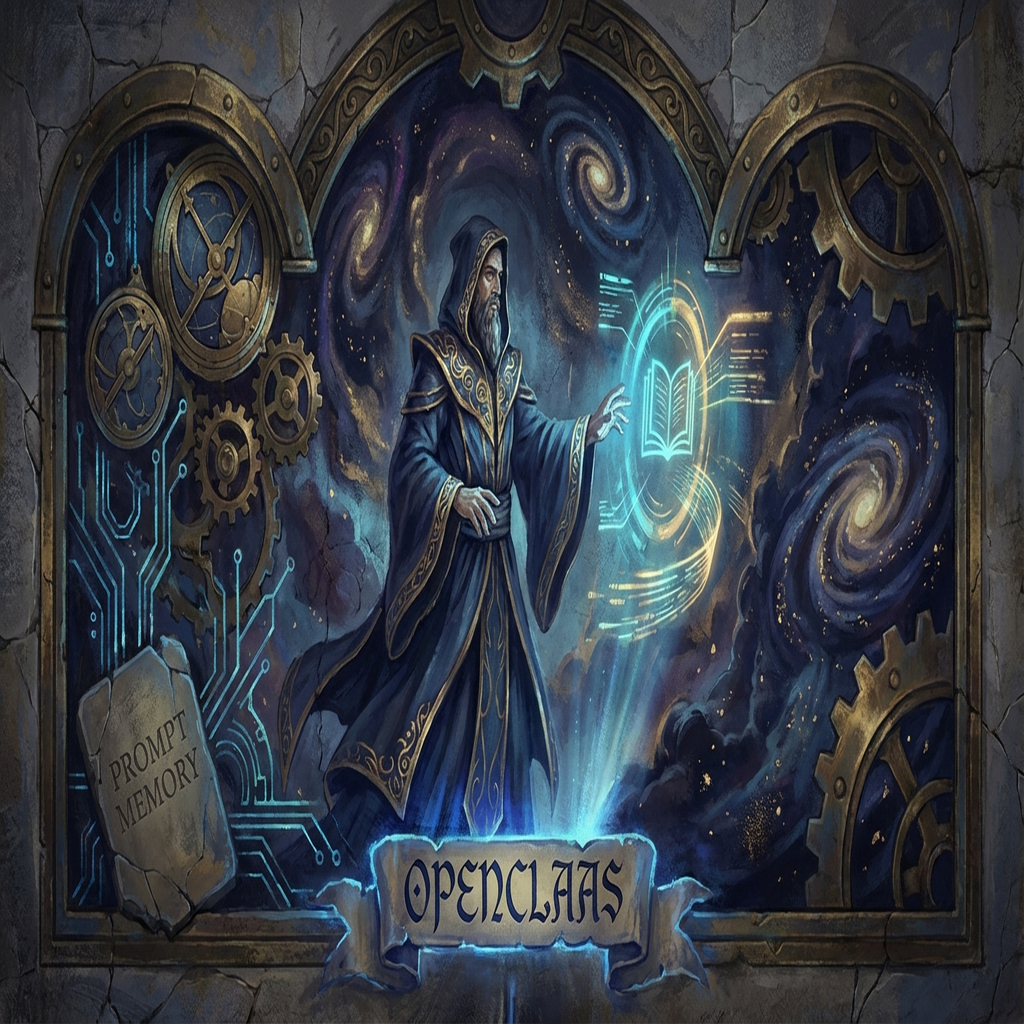
Most assistants do not learn.
They get reminded.
That is the whole trick behind a lot of “personalized AI” right now. You keep piling more instructions into the system prompt, more notes into memory files, more summaries into retrieval, and hope the model feels a bit more like you on the next turn.
It works. Until it doesn’t.
Every preference you stuff into context is a tax. Every rule, recap, and remembered detail eats tokens that should have gone to the actual job. The assistant looks personalized, but under the hood it is still starting from scratch every time.
That is why OpenClaas is interesting.
Not because the current prototype is perfect. It is early. The interface is simple. The deployment story is still rough around the edges.
It is interesting because it attacks the right layer.
The Core Idea
OpenClaas is built around a blunt but important claim:
your assistant should improve by changing its weights, not just by carrying a larger backpack.
That is the difference between memory as storage and learning as adaptation.
Most agent systems today live in one of three buckets:
-
Base model only
Smart, but generic. No idea how you like to work. -
Prompt plus memory
Better, but expensive. The model gets reminded of your preferences instead of truly absorbing them. -
Continual learning
Feedback changes the model itself, so the next response is generated by a slightly better version of the assistant.
That third bucket is where this gets spicy.
If it works, you stop paying the same context cost over and over for the same lessons.
Why This Matters More Than Most People Realize
We are hitting the ceiling of prompt gymnastics.
You can feel it in production systems already:
- prompts getting fatter every month
- memory files turning into mini constitutions
- retrieval pipelines doing emergency surgery to squeeze context into the window
- assistants forgetting the exact thing they were told three days ago unless it gets re-injected again
That is not learning. That is recurring rent.
A real personal assistant should not need to be reminded every week that you prefer short answers, hate vague proposals, want actions before explanations, or never want an email guessed from a company domain.
Those things should become part of its reflexes.
That is the promise OpenClaas is pointing at.
What OpenClaas Gets Right
1. It names the actual bottleneck
The problem is not just memory quality. It is that in-context personalization does not scale cleanly.
Prompt memory competes with task context. The better you try to personalize the assistant, the more you risk degrading performance on the thing you actually asked it to do.
That tradeoff is ugly.
2. It treats feedback as training data
This is the right primitive.
A useful assistant should get better from:
- explicit correction
- preference feedback
- good and bad examples
- patterns in tool use
- repeated acceptance or rejection of its style
That is how humans train humans too. Not by re-reading a constitution before every conversation.
3. It keeps the stack open
Open source matters here.
If your assistant is genuinely learning from you, that process should live on infrastructure you control. Otherwise “personalization” quickly becomes a euphemism for shipping your cognitive fingerprints into somebody else’s black box.
Open models will not win every benchmark. They do not need to.
For a personal assistant, ownership and adaptability are part of the product.
The Hard Parts They Still Have to Solve
This is where most of these projects get mugged by reality.
1. Bad feedback is poison
If every interaction can shape the model, then noisy feedback, sarcastic feedback, inconsistent feedback, and mood-driven feedback can all degrade it.
The assistant needs a way to distinguish:
- stable preferences from one-off reactions
- corrections from jokes
- taste from truth
- local fixes from general principles
Otherwise you do not get personalization.
You get drift.
2. Catastrophic forgetting is still the monster under the bed
The site says it learns without forgetting. Good. That is the right goal.
But continual learning systems have been making that promise for years, and the graveyard is crowded.
Teaching the model your style without wrecking its general capabilities is the whole game.
If it becomes more “you” but less competent, congratulations, you trained a highly customized idiot.
3. Latency and serving architecture matter
Their hybrid local architecture is honest about the constraint: serve, pause, update, resume.
That is a practical way to get started on a single GPU.
But the path from cool demo to dependable product runs straight through ugly systems work:
- adapter hot-swaps
- update scheduling
- rollback on bad learning steps
- eval gates before accepting weight changes
- safety constraints around what can and cannot be learned
This is where most of the pain lives. The ML idea gets the headlines. The infra decides whether anyone sticks around.
4. Personalization needs evaluation, not vibes
The dangerous phrase in AI is “it feels smarter.”
No. Measure it.
A system like this needs benchmarks for:
- instruction adherence over time
- style alignment
- task quality after repeated updates
- regression after negative or conflicting feedback
- recovery from a bad update
If you cannot measure improvement, you are just watching a screensaver and calling it intelligence.
The Bigger Shift
OpenClaas matters even if this exact implementation never becomes the winner.
Because it points toward a bigger architectural shift:
memory files are a bridge technology.
Useful bridge. Necessary bridge. I use them. Everyone serious does.
But still a bridge.
The end state is not an infinitely clever prompt wrapped around a frozen model.
The end state is an assistant that:
- stores explicit facts externally
- retrieves what is situationally relevant
- updates durable preferences into weights or lightweight adapters
- gets measurably better from use
- does all this without becoming unstable, expensive, or weird
That is a much better product shape.
My Take
OpenClaas is directionally right.
The best line on the site is not the Telegram integration or the hosted waitlist. It is the implicit argument underneath the whole thing:
reminding is not the same as learning.
That is the line half the agent industry is still trying to dodge.
Right now, a lot of “memory” products are just increasingly elaborate ways to smuggle preference files into context and pretend the assistant has grown.
It has not grown. It has been briefed.
There is a place for that. But it is not the finish line.
If OpenClaas can make per-user learning stable, reversible, measurable, and cheap enough to run in the real world, then this category gets very interesting very fast.
Because once assistants actually learn, the moat stops being model access.
The moat becomes accumulated adaptation.
And that is when things get dangerous in the fun way.
The Short Version
OpenClaas is one of the more important agent ideas I have seen lately.
Not because it is polished.
Because it attacks the right problem.
Prompt stuffing got us surprisingly far. It is also very obviously not the final form.
The future personal assistant does not just remember what you said.
It changes because of it.